Experiment No.: 3
Experiment Name:
Study & Identify Cables (PVC, XLPE AND VIR) and Catenary Cable of Different Current Ratings
Objective:
- To identify PVC, XLPE, VIR, and Catenary cables.
- To study their construction and insulation.
- To understand their current ratings and applications.
- To compare different types of cables used in electrical installations.
Theory:
Different electrical cables are used for different purposes. The insulation material and conductor size decide the current carrying capacity of a cable. Proper cable selection improves safety and efficiency in electrical systems.
1. PVC Cable :
PVC means Polyvinyl Chloride. It is the most common cable used in houses and buildings.
| Features | Applications |
| Flexible Water resistant Low cost Temperature rating: about 70°C | House wiring Lighting circuits Small electrical appliances |
2. XLPE Cable:
XLPE means Cross-Linked Polyethylene. It can carry higher current and temperature than PVC.
| Features | Applications |
| High insulation strength Heat resistant Long service life Temperature rating: about 90°C | Industrial power supply Underground cables Distribution system |
3. VIR Cable:
VIR means Vulcanized India Rubber. It is an old type of cable that is rarely used today.
| Features | Applications |
| Rubber insulation Good flexibility Lower life compared to modern cables | Old electrical installations |
4. Catenary Cable:
Catenary cables are tensioned wires suspended between two points that support their own weight and additional loads, forming a catenary curve.
They are primarily used in railway electrification (as messenger wires) and for overhead support of cables, lighting, and signage in commercial or industrial settings.
| Features | Applications |
| Strong mechanical support Suitable for overhead installation Can carry heavy loads | Railway electrification Street lighting Outdoor wiring Industrial overhead installations |
Apparatus Used:
| Sl. No. | Name of the Apparatus | Specification | Quantity |
| 1. | PVC cable samples | Copper conductor, 1.1kV 2.5 sq. mm | 1 m |
| 2. | XLPE cable samples | Aluminum conductor, 11Kv 25 sq. mm | 1 m |
| 3. | VIR cable sample | Copper conductor, 650V 4 sq. mm | 1 m |
| 4. | Catenary cable sample | As available | 1 m |
| 5. | Digital Multimeter | 0-650 V, 0-10A | 1 |
Cables Observation:
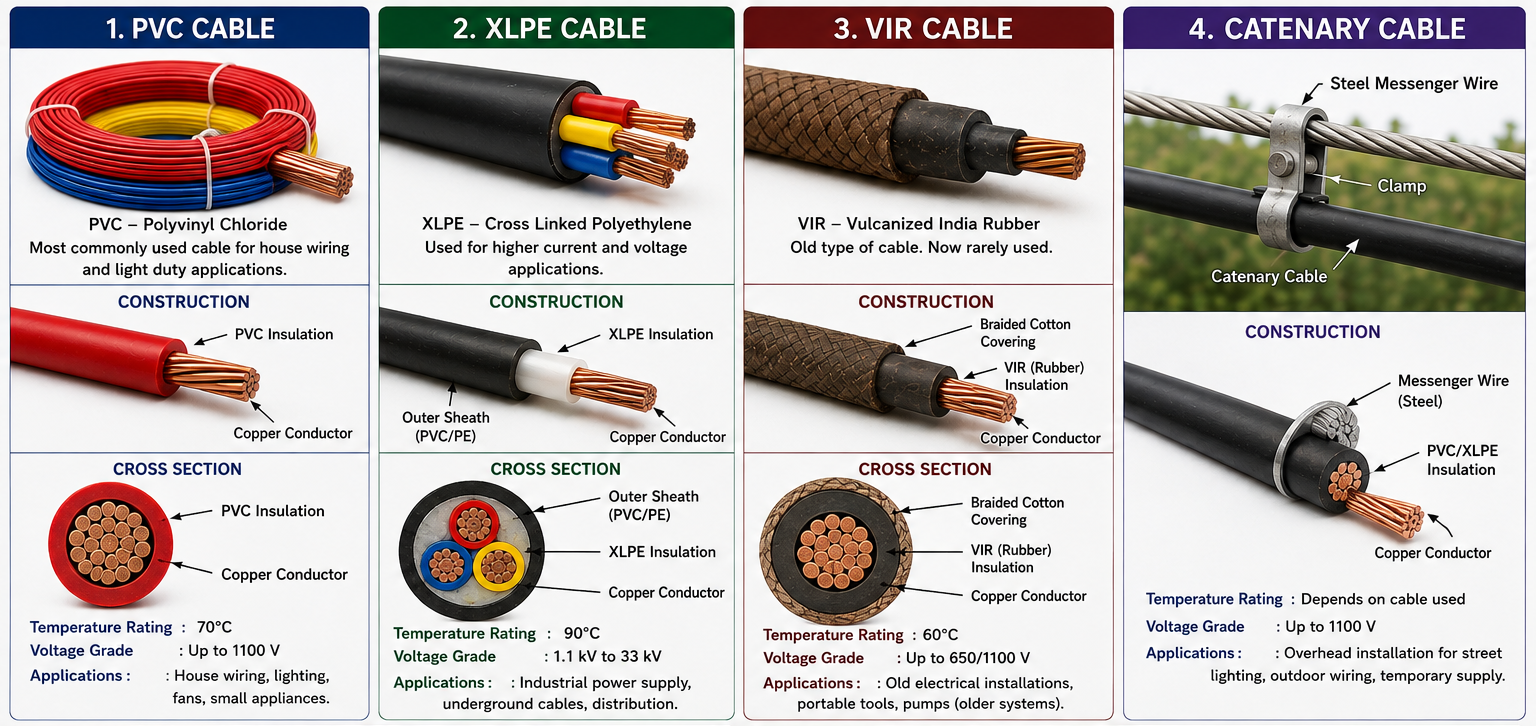
Observation Table:
| Cable Type | Insulation | Temperature | Common Use |
|---|---|---|---|
| PVC | Polyvinyl Chloride | 70°C | House wiring |
| XLPE | Cross-Linked Polyethylene | 90°C | Industrial power |
| VIR | Rubber | Around 60°C | Old wiring |
| Catenary | PVC/XLPE with messenger wire | Depends on cable | Overhead wiring |
Common Current Rating:
| Cable Size | Approx. Current |
|---|---|
| 1.5 mm² | 10–14 A |
| 2.5 mm² | 18–24 A |
| 4 mm² | 25–32 A |
| 6 mm² | 32–40 A |
| 10 mm² | 45–60 A |
Note: Current rating may change depending on installation conditions.
Procedure:
- Collect different cable samples.
- Observe the insulation colour and thickness.
- Identify each cable by its marking.
- Measure the conductor size using a wire gauge or measuring tool.
- Compare their insulation material.
- Note the approximate current rating.
- Record the application of each cable.
Observation Table:
| Cable | Size | Insulation | Current Rating |
|---|---|---|---|
| PVC | 2.5 mm², Copper | PVC | 20 A |
| XLPE | 25 mm², Aluminum | XLPE | 100 A |
| VIR | 4 mm², Copper | Rubber | 24 A |
| Catenary | 6 mm², Copper | PVC + Messenger | 40 A |
Conclusion:
PVC, XLPE, VIR, and Catenary cables were successfully identified. Their insulation type, current rating, and practical applications were studied and compared.
Viva Questions:
- What is the full form of PVC?
- Which cable has a higher temperature rating: PVC or XLPE?
- Why is XLPE used in industries?
- What is VIR cable?
- Where is a Catenary cable commonly used?
- Which cable is suitable for overhead installation?
- What is the purpose of the messenger wire?
- Does cable size affect current carrying capacity?
Views: 275